

Table of Contents
Choosing the right foundation drilling rigs and equipment is one of the first decisions that determines whether a drilled foundation project stays productive, safe, and within tolerance. A drilled shaft rig, CFA drilling rig, micropile drilling rig, or rotary drilling rig is not selected by diameter alone. The right setup depends on subsurface conditions, required depth, access, overhead clearance, groundwater, casing requirements, spoil handling, tooling availability, crew experience, and the production rate needed to meet the schedule. This guide explains the major rig types, how they are used, what equipment supports them, and what factors control daily production in real foundation drilling work.
Foundation Drilling Equipment Overview
Rigs, Tooling, and Support Systems
Foundation drilling equipment is best understood as a complete system rather than a single machine. The rig provides torque, crowd force, hoisting capacity, rotation, pullback, mast alignment, and mobility. The tooling cuts or advances the hole. Temporary casing, slurry systems, grout plants, concrete pumps, spoil handling equipment, lifting equipment, compressors, water supply, reinforcement handling, and testing access all determine whether the rig can actually perform as planned.
A rotary drilling rig may have enough torque to cut dense sand or weathered rock, but the project can still lose production if casing vibrators are undersized, spoils cannot be cleared, reinforcement cages are delayed, or concrete delivery is inconsistent. A micropile drilling rig may fit inside a low-headroom structure, but it will not be productive if the grout plant, air compressor, tooling, and casing stock are not matched to the drilling method. A CFA drilling rig may install piles quickly in favorable soils, but only if the grout or concrete delivery system can maintain continuous pressure and volume during auger withdrawal.
The contractor’s equipment plan should therefore include the base rig, tool string, casing plan, fluid or grout system, spoil management plan, lifting plan, access plan, and inspection points. The most reliable foundation drilling operations are built around compatibility between these components.
What a Foundation Drilling Rig Must Do
A foundation drilling rig must create a hole or pile element that meets the required diameter, depth, alignment, bearing condition, reinforcement requirements, and concrete or grout placement requirements. For drilled shafts, the rig excavates a cylindrical hole that may be dry, cased, or slurry-supported, then reinforcement and concrete are placed. FHWA guidance treats drilled shafts as cast-in-place deep foundations and covers common construction issues such as excavation methods, casing, slurry, reinforcement, concrete placement, inspection, and testing.
For CFA piles, the rig advances a continuous flight auger to depth and places grout or concrete through the hollow stem as the auger is withdrawn. For micropiles, the rig advances a small-diameter borehole using rotary, rotary percussion, duplex, down-the-hole hammer, or other drilling techniques, then installs reinforcement and grout. For anchors, tiebacks, and soil nails, similar drilling systems are used, but the final element is designed primarily for tensile load or ground support rather than compressive pile capacity.
Main Types of Foundation Drilling Rigs
Kelly Bar Drilled Shaft Rigs
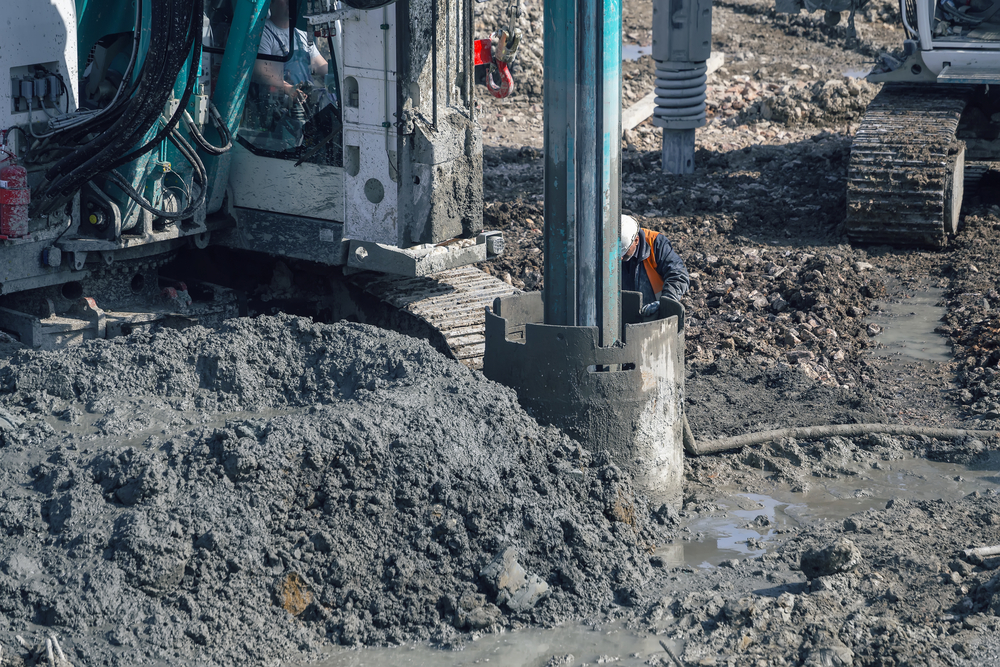
Kelly bar rigs are among the most common machines used for drilled shaft construction. They use a telescoping kelly bar to transfer torque and crowd force from the rotary drive to the drilling tool. Depending on the rig, the kelly bar may be friction type or interlocking type. Friction kelly bars are typically used where high crowd transfer is less critical, while interlocking kelly bars are used where greater crowd force is needed, such as hard soils, dense strata, or rock sockets.
A drilled shaft rig using a kelly bar can run augers, drilling buckets, cleanout buckets, core barrels, belling tools, rock augers, and other tools. This makes it versatile for bridge foundations, transmission structures, high-rise buildings, marine work, sound walls, tanks, and industrial foundations. The major advantage is flexibility. The contractor can change tooling as the ground changes. The major limitation is that production depends heavily on the excavation cycle. The tool must be advanced, filled, extracted, swung away, emptied, and returned to the hole.
Kelly bar rigs are often selected when shaft diameters are large, depths are moderate to deep, soil layers are variable, rock sockets are required, or casing and slurry methods may be needed. They can be mounted on crawler carriers or adapted to crane-mounted systems. Modern dedicated hydraulic rigs usually offer better mast control, faster setup, and integrated monitoring than older crane-mounted systems, but crane-mounted drilling equipment may still be used in certain heavy civil or marine applications.
Continuous Flight Auger Rigs
A CFA drilling rig installs piles by rotating a continuous flight auger into the ground without removing the auger from the hole until final depth is reached. Concrete or grout is then pumped through the hollow stem while the auger is withdrawn. The soil carried on the auger flights is removed at the surface while the pile is formed from the bottom upward.
CFA rigs are productive in many sands, silts, clays, and mixed soils where the bore can be supported by the auger during drilling and by pressure concrete or grout during withdrawal. They are often used for commercial buildings, sound walls, earth retention support, industrial slabs, tanks, and urban projects where vibration must be limited. They can be faster than drilled shaft methods because they eliminate separate open-hole excavation, cage placement before concrete, and tremie setup in many cases.
The tradeoff is that CFA piles require tight control over auger withdrawal rate, pump volume, pressure, depth, rotation, and spoil removal. Reinforcement is usually installed after grouting or concreting, which can limit cage length, bar size, and reinforcement configuration. Obstructions, very dense ground, cobbles, boulders, and hard rock can reduce productivity or make CFA unsuitable. The rig must also have sufficient torque and crowd to reach design depth without uncontrolled soil mining or refusal.
Micropile Drilling Rigs
A micropile drilling rig is usually smaller, more maneuverable, and more adaptable than a large drilled shaft rig. Micropile rigs are used for small-diameter drilled and grouted piles that can work in restricted access, low overhead, sloping terrain, existing buildings, and difficult ground. They are common for underpinning, seismic retrofit, bridge repair, limited-access foundations, landslide stabilization, tower foundations, and retrofit work where larger equipment cannot reach.
Micropile drilling equipment can include rotary heads, rotary percussion heads, duplex casing systems, down-the-hole hammers, top hammers, flush systems, grout plants, high-pressure pumps, casing oscillation systems, and compact power packs. The rig may be crawler-mounted, skid-mounted, excavator-mounted, or configured for low headroom work. Many micropile rigs can drill at battered angles, which is useful for resisting lateral loads or installing reticulated groups.
The main advantage of micropile drilling rigs is access. They can work where large rigs cannot. The main limitation is production volume. Micropiles are usually smaller and more numerous than drilled shafts. Production depends on drilling difficulty, casing requirements, grout staging, reinforcement handling, and verification testing. In many projects, the drilling rig is not the only limiting factor. Grout mixing capacity, casing extraction, bar coupling, and quality control paperwork can control the actual daily output.
Rotary Drilling Rigs
The term rotary drilling rig is broad. In foundation work, it usually refers to equipment that advances tooling by rotation, with or without crowd force, casing, slurry, air, water, or drilling fluid. Kelly bar drilled shaft rigs are a form of rotary drilling rig, but the term can also include smaller rotary rigs for micropiles, anchors, tiebacks, probe holes, and specialty ground improvement.
Rotary drilling is used because it can be adapted to many ground conditions. In cohesive soils, augers and buckets may be sufficient. In granular soils below groundwater, casing or slurry may be required. In rock, core barrels, rock augers, roller bits, down-the-hole hammers, or reverse circulation tools may be needed. The rig selection depends on torque, rotation speed, crowd, pullback, mast stiffness, and the ability to handle casing and tool strings safely.
Low-Headroom and Limited-Access Rigs
Low-headroom foundation drilling rigs are used inside buildings, under bridges, beneath power lines, in basements, in tunnels, and in tight urban sites. They are often used for micropiles, underpinning, tiebacks, and small drilled shafts. These rigs sacrifice mast height and sometimes tooling length to fit into restricted spaces. Short mast sections, segmented casing, short drill rods, and compact tooling are common.
The production penalty can be significant. Every rod, casing, or tool section may require more connections. Spoil removal is often slower. Ventilation, lighting, access, and material handling become more important. Low-headroom work also tends to require more manual handling unless the contractor provides proper lifting aids. Selection should be based not only on whether the rig fits, but whether the entire operation can be performed safely and repeatedly.
Crane-Attached and Excavator-Mounted Drilling Attachments
Some foundation drilling is performed with attachments mounted on cranes, excavators, or other carriers. These systems can be useful for smaller-diameter shafts, utility foundations, sound walls, light pole bases, signs, fencing, and work where a dedicated drill rig is not economical. Excavator-mounted auger drives are common for shallow holes and smaller foundations. Crane-mounted rotary equipment can be used for larger work when properly configured.
The limitation is control and capacity. Dedicated foundation drilling rigs generally provide better mast guidance, crowd force, torque delivery, and instrumentation. Attachments can be efficient for the right scope, but they should not be assumed to perform like dedicated rigs in deep, wet, cased, or rock-socketed work. The contractor must verify torque, crowd, hoisting, reach, stability, and tooling compatibility before relying on an attachment.
Common Foundation Drilling Equipment by Application
|
Application |
Typical Rig Type |
Common Tooling and Support Equipment |
Main Production Drivers |
|---|---|---|---|
|
Large drilled shafts |
Kelly bar drilled shaft rig or crane-mounted rotary system |
Augers, buckets, cleanout buckets, core barrels, temporary casing, slurry system, cage handling equipment, tremie equipment |
Diameter, depth, casing time, rock socket length, spoil removal, concrete delivery |
|
CFA piles |
CFA drilling rig |
Continuous flight auger, hollow stem, grout or concrete pump, automated monitoring, spoil cleaning equipment |
Torque, auger depth, pump rate, withdrawal rate, reinforcement installation, spoil handling |
|
Micropiles |
Compact rotary or rotary percussion micropile drilling rig |
Drill rods, casing, duplex tooling, DTH hammer, grout plant, reinforcement bars or casing |
Access, ground hardness, casing advancement, grout stages, bar coupling, testing |
|
Ground anchors and tiebacks |
Anchor drilling rig or micropile rig |
Rotary or percussion tooling, casing, tendon handling, grout pump, stressing jack |
Bond length drilling, inclination control, obstruction management, grouting, stressing sequence |
|
Rock sockets |
High-torque rotary rig |
Core barrels, rock augers, roller bits, cleanout tools, casing where needed |
Rock strength, socket diameter, tool wear, cleanout time, inspection requirements |
|
Low-headroom underpinning |
Low-headroom micropile rig |
Short rods, sectional casing, compact grout plant, lifting aids |
Connection frequency, access, spoil removal, ventilation, material handling |
Selecting a Foundation Drilling Rig
Start With the Geotechnical Report
The geotechnical report is the starting point for rig selection. It identifies soil layers, rock conditions, groundwater, standard penetration resistance, rock quality, unconfined compressive strength, boulders, obstructions, fill, contamination concerns, and expected drilling behavior. A rig that is suitable for soft clay may not be suitable for dense sand with cobbles. A rig that can reach depth in dry soil may struggle when the same hole must be advanced through flowing sand below groundwater.
Contractors should review boring logs, lab data, groundwater observations, historical site use, nearby foundation records, and obstruction risks before selecting equipment. For drilled shafts, this review determines whether dry excavation, temporary casing, permanent casing, slurry, or full-depth casing may be required. For CFA piles, it determines whether the auger can maintain stability and whether installation parameters are likely to be controllable. For micropiles, it determines whether open-hole drilling is possible or whether casing, duplex drilling, or percussion methods are needed.
Match Torque, Crowd, and Pullback to the Work
Torque helps rotate tooling through soil and rock. Crowd force helps push the tool into the ground. Pullback helps extract tooling, augers, casing, or drill strings. These values matter because difficult ground does not only slow drilling. It can trap tooling, twist auger flights, overload rotary heads, or create unsafe extraction conditions.
For drilled shaft rigs, torque and crowd must be matched to diameter, depth, soil density, rock strength, and tool type. Larger diameters require more torque because the cutting radius increases. Rock drilling requires not only torque, but also the correct tool geometry and crowd force. For CFA rigs, torque must be sufficient to advance the continuous auger to depth without excessive flight refusal or uncontrolled drilling. Pullback must be sufficient to withdraw the auger at the controlled rate needed for proper concrete or grout placement.
For micropiles, the rig may need lower torque but higher percussion energy or greater feed force, depending on method. Duplex drilling through mixed ground requires enough rotation and feed to advance both casing and drill string. DTH hammer drilling requires enough air volume and pressure to run the hammer and clear cuttings.
Confirm Depth, Diameter, and Mast Capacity
Published rig capacity is not the same as practical production capacity. A rig may have a maximum drilling depth under ideal tool configuration, but the usable depth may be less when casing, heavy tools, rock sockets, battered drilling, or limited working room are involved. A rig may also have a maximum diameter rating, but production at that diameter may be slow in dense or hard ground.
Mast height affects tool length, casing handling, kelly bar configuration, and reinforcement handling. A tall mast can improve production by reducing tool connections and allowing longer casing or auger sections. A short mast may be necessary for access but can reduce output. When evaluating a drilled shaft rig, the contractor should look at the full tool string, not just the hole depth. The length of the drilling tool, kelly bar, casing sections, hook height, and spoil dumping geometry all affect whether the rig can work efficiently.
Evaluate Access, Working Platform, and Stability
Foundation drilling rigs are heavy machines that require stable working platforms. The platform must support crawler loads, turning movements, casing handling, tool extraction, spoil stockpiles, concrete trucks, pumps, cranes, and service equipment. A rig that is technically capable of drilling the shaft may still be unsafe if the working platform is weak, sloped, saturated, undermined, or obstructed.
Rig overturn is a known hazard in deep foundation construction. NIOSH has specifically warned that drill rigs and other specialty deep foundation equipment can overturn, and that deep foundation work includes hazards such as falls, caught-in or between incidents, struck-by incidents, and electrocution.
A proper working platform plan should consider subgrade strength, drainage, matting, ramps, slopes, proximity to excavations, underground utilities, overhead utilities, travel paths, and the sequence of drilling. The issue is not only whether the rig can stand at the first hole. It must move repeatedly across the site while carrying tools, spoil, casing, and sometimes a partially loaded mast.
Consider Groundwater and Hole Stability
Groundwater changes rig selection because it affects excavation stability and concrete placement. In dry cohesive soils, a drilled shaft may be excavated open and inspected visually. In unstable granular soils or soils below groundwater, temporary casing or slurry support may be needed. This changes the equipment package. The job may require casing vibrators, oscillators, casing rotators, slurry tanks, desanding equipment, tremie pipe, and additional inspection controls.
For CFA piles, groundwater is often less disruptive because the auger supports the hole during drilling and grout or concrete is placed as the auger is withdrawn. However, groundwater still affects spoil behavior, pressure control, and potential necking or inclusions if the installation process is not controlled. For micropiles, groundwater can influence flushing method, casing requirements, grout take, and hole cleaning.
Plan Around Obstructions
Obstructions are one of the most common reasons foundation drilling production falls behind. Old foundations, timber piles, debris fill, riprap, boulders, utilities, concrete slabs, and buried steel can stop a production rig that was selected for normal soils. The right response depends on the obstruction type. A larger rotary rig may be needed for drilling through concrete or boulders. A core barrel may be required. A down-the-hole hammer may be more effective in hard rock. In urban work, vacuum excavation or predrilling may be needed to identify utilities or remove shallow conflicts.
The contractor should not assume that a single drilling tool will solve every obstruction. Obstruction removal often requires a separate plan, including excavation equipment, coring tools, casing, specialty bits, lifting devices, and time for engineer review if the foundation location or design must change.
Tooling for Foundation Drilling
Augers
Augers are used to cut and remove soil. They may be earth augers, rock augers, short-flight augers, continuous flight augers, or specialized designs. Earth augers work well in cohesive soils and some granular soils. Rock augers use stronger teeth and heavier construction. Continuous flight augers are central to CFA pile installation and are also used in some drilled shaft applications.
The advantage of an auger is that it can cut quickly and carry soil to the surface. The disadvantage is that it may not clean the base of a drilled shaft as well as a bucket, and it can disturb unstable soils if used improperly. In wet granular ground, augers can also loosen material or contribute to instability if the hole is unsupported.
Drilling Buckets and Cleanout Buckets
Drilling buckets are common on drilled shaft rigs. They cut soil and collect spoil inside the bucket. They are often used in granular soils, mixed soils, and slurry-supported holes. Cleanout buckets are used to remove loose material from the bottom of the excavation. Base cleanliness matters because loose sediment can reduce end bearing and affect the quality of the shaft base.
Bucket selection depends on soil type, diameter, bottom condition, and whether the hole is dry, wet, cased, or slurry-supported. A bucket that works in clay may not work well in sand. A cleanout bucket that is too light may not remove dense sediment. Production depends on how quickly the bucket fills, how cleanly it dumps, and how many passes are required.
Core Barrels and Rock Tools
Core barrels are used to cut rock sockets, hard layers, boulders, and concrete obstructions. A core barrel cuts an annular ring, leaving a central plug that may be broken and removed. Rock augers, roller bits, belling tools, and specialized cutting heads may also be used. Tool wear is a major production factor in rock. Tooth type, cutter layout, crowd force, rotation speed, and cooling or flushing all affect performance.
Rock socket production is often slower than soil drilling. The contractor should separate soil excavation production from rock socket production when estimating the schedule. A shaft that takes one hour to drill through soil may take many additional hours to complete if the socket is long, the rock is strong, or cleanout requirements are strict.
Casing Systems
Temporary casing supports the excavation and prevents unstable soils or groundwater from entering the hole. It can be advanced by twisting, vibrating, oscillating, rotating, or driving, depending on the project and equipment. Permanent casing may be required for structural, environmental, marine, or constructability reasons.
Casing selection affects rig choice. Large-diameter casing requires handling capacity and may require a casing oscillator or rotator. Extracting casing during concrete placement requires careful timing and enough equipment capacity to prevent defects. For micropiles, casing may be advanced with duplex drilling or left in place as reinforcement. The equipment plan must state whether casing is temporary or permanent, how it is advanced, how it is cleaned, and how it is extracted.
Slurry Systems
Slurry can support drilled shaft excavations when casing is not practical or when open-hole stability is required below groundwater. Mineral slurry or polymer slurry may be used depending on specifications, ground conditions, and contractor experience. A slurry system includes mixing, storage, circulation, testing, cleaning, and disposal. The rig cannot be evaluated alone when slurry is required. Slurry quality and hole cleaning become part of the production cycle.
Poor slurry management can slow excavation, increase sediment, complicate concrete placement, and cause acceptance problems. Good slurry work requires trained personnel, testing equipment, clean tanks, desanding capacity where needed, and enough space on site for fluid handling.
Grout and Concrete Equipment
CFA piles, micropiles, anchors, and some drilled elements depend on grout or concrete pumping equipment. The pump must deliver the required volume and pressure at a rate matched to drilling and withdrawal. Lines must be sized and routed to reduce blockage risk. Mixers, agitators, pumps, pressure gauges, flow meters, and backup equipment may be needed.
For CFA piles, the relationship between auger withdrawal and grout or concrete volume is critical. If the auger is withdrawn too quickly or pump delivery is interrupted, defects can occur. For micropiles, grout mix, grout pressure, grout stage, and casing extraction sequence are central to performance. Equipment selection must account for both installation and quality control.
Production Factors That Control Daily Output
Soil and Rock Conditions
Ground conditions are the largest production variable. Soft to medium cohesive soils may drill quickly. Dense sands, gravels, cobbles, boulders, hardpan, weathered rock, and hard rock can reduce rates dramatically. Mixed-face conditions are especially difficult because the contractor may need to switch tools repeatedly. A drilled shaft passing from clay into gravel and then into rock may require an auger, bucket, casing, core barrel, and cleanout tool in one hole.
Production estimates should be broken into activities. Drilling soil, advancing casing, drilling rock, cleaning the base, placing reinforcement, placing concrete, extracting casing, and moving to the next location should be estimated separately. A single average footage rate can hide the real schedule risk.
Diameter and Depth
Larger diameters take more time because more material must be excavated and handled. Deeper holes take more time because each cycle takes longer, tool travel increases, alignment control becomes more important, and spoil handling grows. Deep holes also increase risk of instability, tool sticking, and concrete placement complications.
A small increase in diameter can create a large increase in excavation volume. For example, increasing shaft diameter increases the cross-sectional area of the hole, which directly increases spoil volume and concrete volume. This affects drilling time, truck count, concrete supply, disposal, and inspection time.
Setup and Move Time
The time between holes can control production on many sites. A fast drilling rig may still produce slowly if hole locations are spread out, access roads are poor, mats must be moved, spoils block travel, or survey layout is not ready. Urban projects often lose time to traffic control, restricted delivery windows, noise limits, utility protection, and limited staging.
Move time should include raising and lowering the mast, tracking between locations, positioning mats, checking verticality or batter angle, setting casing, aligning tooling, and confirming layout. On tight sites, this time may exceed drilling time for shallow elements.
Spoil Handling
Every drilled foundation creates spoil unless it is a displacement method. Spoil must be removed from the tool, moved away from the rig, stockpiled or loaded, tested if contaminated, and hauled off if required. CFA rigs can generate continuous spoil during drilling and withdrawal. Drilled shaft rigs generate spoil in cycles. Micropile rigs may create cuttings mixed with water, air, grout, or drilling fluid.
Poor spoil management slows the rig, creates safety hazards, blocks access, increases cleanup costs, and can contaminate reinforcement or concrete placement areas. A productive site has a planned spoil route, loader or excavator support, haul trucks, containment where needed, and enough room to keep the rig working.
Concrete, Grout, and Reinforcement Delivery
The drilling rig is only productive if downstream activities keep pace. Drilled shafts require reinforcement cages and concrete to be ready when the hole is accepted. If concrete is delayed, the hole may deteriorate, slurry properties may change, or casing extraction timing may be affected. CFA piles require continuous grout or concrete delivery during withdrawal. Micropiles require grout materials, water, cement, admixtures if specified, bars, casing, couplers, centralizers, and tremie or grout tubes.
A common production mistake is estimating only drilling time. Foundation drilling is a chain operation. The slowest link may be cage fabrication, crane availability, grout batching, concrete trucks, testing, or inspection signoff.
Inspection and Testing Hold Points
Inspection requirements can affect production in a major way. Drilled shafts may require bottom inspection, slurry testing, depth confirmation, cage inspection, concrete volume checks, and placement records. CFA piles may require automated installation monitoring, grout volume verification, pressure review, and integrity testing. Micropiles may require grout logs, proof tests, verification tests, reinforcement inspection, and staged acceptance.
These controls are necessary, but they must be built into the schedule. A rig standing idle while waiting for inspection is a planning problem, not just a field problem. The contractor should identify hold points early and coordinate with the owner, engineer, testing agency, and concrete or grout suppliers.
Safety and Compliance Considerations
Rig Stability and Working Platforms
Rig stability begins before drilling starts. The working platform must be designed, built, maintained, and inspected for the loads imposed by the rig and support equipment. Soft ground, voids, trenches, slopes, wet subgrades, and poorly compacted fill create overturn and settlement risk. Mats can help, but mats must be correctly sized and placed.
Operators should avoid traveling with unnecessary mast height, excessive tool swing, or suspended loads unless the machine is designed and configured for that operation. Drilling near excavations, slopes, utilities, water, or traffic requires additional planning. A foundation drilling rig is not just a drill. It is a heavy rotating machine with high centers of gravity, suspended tools, hydraulic systems, and workers on the ground nearby.
Utilities and Overhead Hazards
Underground and overhead utilities are critical hazards. Before drilling, utilities should be identified, marked, exposed where required, and protected. Overhead power lines require clearance planning for masts, cranes, casing, reinforcement cages, concrete pump booms, and delivery trucks. Low-headroom work creates different hazards, including ventilation, lighting, exhaust, confined access, and restricted escape paths.
The equipment plan should include utility clearance drawings, exclusion zones, spotters where needed, and stop-work authority when unknown utilities or obstructions are found.
Rotating Equipment and Exclusion Zones
Foundation drilling involves rotating tools, augers, rods, casing, hoses, and suspended components. Workers should stay clear of rotating equipment and pinch points. CFA operations require special care around spoil cleaners, auger flights, grout lines, and pressurized systems. Micropile drilling requires care around rotating rods, casing joints, hammer systems, grout pumps, and high-pressure hoses.
Good crews maintain clear communication between operator, signal person, laborers, inspectors, pump operators, and truck drivers. Radios, hand signals, and defined work zones reduce confusion. The best equipment cannot compensate for uncontrolled personnel movement around a drilling operation.
Equipment Selection for Common Project Types
Bridges and Transportation Structures
Bridge foundations often use drilled shafts, micropiles, or driven piles depending on site conditions and design. When drilled shafts are selected, rigs must often handle large diameters, deep excavations, casing, slurry, rock sockets, and strict inspection. Access may be constrained by traffic, water, railroads, slopes, or existing structures. Production planning should include casing handling, cage lifting, concrete delivery, and inspection coordination.
Commercial and Industrial Buildings
Commercial buildings may use drilled shafts, CFA piles, micropiles, or augered piles depending on loads, settlement limits, vibration concerns, and site access. CFA rigs can be productive on open sites with suitable soils and repetitive pile layouts. Drilled shaft rigs may be preferred for higher loads, larger diameters, or bearing in rock. Micropile rigs are often used for additions, retrofits, or restricted access.
Urban Retrofit and Underpinning
Urban retrofit work often favors micropile drilling rigs because they can work in limited access and low-headroom spaces with minimal vibration. Equipment selection should focus on machine size, exhaust, electric or hydraulic power options, spoil handling, grout plant location, noise, and material movement. The drilling method must also protect existing foundations and adjacent structures.
Transmission, Wind, and Utility Foundations
Transmission poles, substations, wind-related structures, signs, and light poles often require drilled foundations in remote or linear work zones. Equipment mobility becomes important. A rig may need to travel long distances between holes, work on uneven terrain, and drill through variable soils. Support trucks, water, concrete delivery, tooling, and maintenance must be planned around remote access.
Cost Drivers for Foundation Drilling Rigs and Equipment
Mobilization and Rig Size
Large rigs cost more to mobilize, transport, assemble, and support. They may require permits, escorts, crane assistance, mats, and larger crews. Smaller rigs are easier to mobilize but may be slower or incapable of the required diameter and depth. The lowest day rate is not always the lowest cost. A larger rig that completes the work faster may be more economical than a smaller rig that struggles.
Tooling and Wear
Tooling cost can be significant in rock, cobbles, hardpan, or abrasive soils. Teeth, bits, pilot tools, core barrels, casing shoes, auger flights, hammer parts, and drill rods wear over time. Hard drilling also increases fuel use, maintenance, and downtime. Estimates should include tooling wear and backup tools.
Standby and Downtime
Standby can come from weather, inspection delays, concrete delays, grout plant issues, equipment breakdown, utility conflicts, obstruction removal, access problems, or design changes. Foundation drilling equipment is expensive to idle. A strong preconstruction plan reduces standby by confirming submittals, layout, materials, testing requirements, and site readiness before mobilization.
How to Build a Practical Equipment Plan
Define the Production Sequence
A useful equipment plan describes how each foundation element will be built from layout to completion. For drilled shafts, that means mobilization, working platform preparation, casing or slurry setup, drilling, cleanout, inspection, reinforcement placement, concrete placement, casing extraction if applicable, and testing access. For CFA piles, it means drilling, pumping, withdrawal, spoil removal, reinforcement installation, monitoring, and testing. For micropiles, it means drilling, flushing, casing, reinforcement, grouting, casing extraction or permanent casing, testing, and cutoff.
The plan should identify what equipment is required at each step. It should also identify what backup equipment is available if a pump, compressor, crane, or rig component fails.
Assign Realistic Production Rates
Production rates should be based on comparable ground, comparable diameters, comparable access, and comparable inspection requirements. A contractor’s best historical rate on an open site should not be used for a tight urban site with casing, utilities, and restricted delivery hours. Likewise, micropile rates from open access work should not be applied directly to basement underpinning with low headroom and short casing sections.
Good production planning uses ranges. It separates normal drilling from difficult drilling. It accounts for setup, movement, casing, tooling changes, reinforcement, concrete or grout placement, testing, and cleanup. This is the difference between a bid schedule and a buildable schedule.
Coordinate Equipment With Quality Control
The equipment must support the quality requirements. If the specification requires automated monitoring for CFA piles, the rig must have functioning instrumentation and reporting. If drilled shafts require slurry testing, the contractor must have equipment and trained personnel to test density, viscosity, sand content, and other specified properties. If micropiles require grout pressure records and proof testing, gauges, pumps, jacks, and calibration records must be available.
Quality control should not be treated as paperwork after the fact. It is part of the equipment system. A productive crew records the work while it is being performed, because missing records can create acceptance problems even when the physical work is sound.
Common Equipment Selection Mistakes
Selecting by Diameter Only
A common mistake is choosing a rig because it can drill the specified diameter. Diameter matters, but it is not enough. The rig must also reach depth, handle the tool string, advance casing if needed, work in the available access, maintain alignment, manage spoils, and support the required production rate. A rig that can drill a 6-foot shaft in dry soil may not be suitable for a 6-foot shaft with full-length temporary casing and a rock socket.
Ignoring Support Equipment
Another mistake is focusing on the drilling rig while underestimating support equipment. Concrete pumps, grout plants, compressors, generators, casing equipment, cranes, loaders, water tanks, slurry tanks, desanders, welders, service trucks, and testing equipment all affect production. A powerful rig without support becomes an expensive idle asset.
Underestimating Access Constraints
Access constraints reduce productivity more than many schedules allow. Narrow gates, soft ground, overhead wires, night work, traffic control, nearby structures, limited laydown, and restricted spoil storage all slow the operation. A compact rig may solve access but add connection time. A large rig may improve drilling but require more platform preparation. The best choice is project-specific.
Failing to Plan for Changed Conditions
Subsurface conditions are never fully known. Contractors should plan for reasonable variations, including harder layers, groundwater changes, obstructions, and unstable zones. Backup tooling, casing options, alternate drilling methods, and a clear communication process with the engineer can prevent a difficult hole from stopping the whole project.
Foundation drilling rigs are selected for the work they must perform, not for their nameplate capacity alone. A drilled shaft rig must be matched to diameter, depth, casing, slurry, rock, reinforcement, and concrete placement. A CFA drilling rig must be matched to soil conditions, grout or concrete delivery, auger withdrawal control, and monitoring. A micropile drilling rig must be matched to access, casing, drilling method, grout staging, and testing. A rotary drilling rig must be evaluated as part of a complete system that includes tooling, support equipment, crews, inspection, and site logistics.
The most successful projects start with a realistic equipment plan. That plan connects the geotechnical report to the rig, the tooling, the working platform, the support equipment, the quality control requirements, and the production schedule. When those pieces fit together, foundation drilling becomes predictable. When they do not, the job is controlled by downtime, rework, unsafe conditions, and avoidable cost.